Terraform
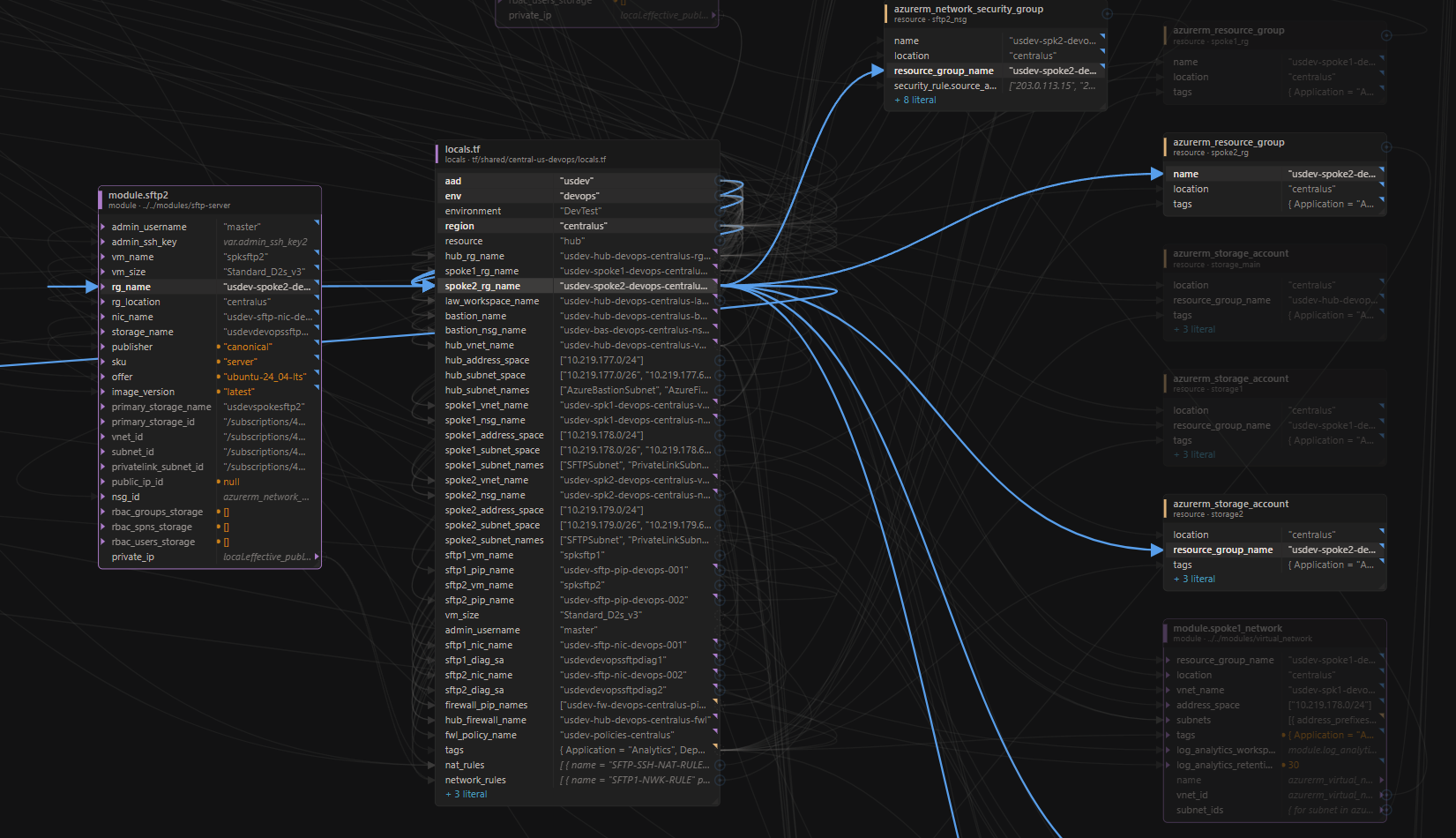
Terraform is where SchematIaC started, and it is still the fullest experience. Open your .tf and .tfvars files on one canvas — every block becomes a node, every attribute a row, every reference a wire — and see what each value actually resolves to, in place.
Works with OpenTofu too — the same HCL — and needs no terraform binary. Looking for Azure Bicep? It is a peer language on the same canvas.
| Terraform | On the canvas |
|---|---|
resource, data, module | one node each, attributes as rows |
variable blocks | one node per file, one row per variable |
.tfvars entries | one node per file, one row per assignment |
locals, output | one node per file, one row per name |
var.x, local.y, aws_vpc.main | a wire into the consuming row |
The canvas evaluates your HCL locally and shows the computed value, not the expression. Anything that genuinely cannot be known before terraform apply reads (known after apply) rather than a guess.
| Written in the file | Shown on the canvas |
|---|---|
| "${var.env}-acme" | "dev-acme" |
| var.bucket_name | "acme-dev-artifacts" |
| aws_vpc.main.id | (known after apply) |
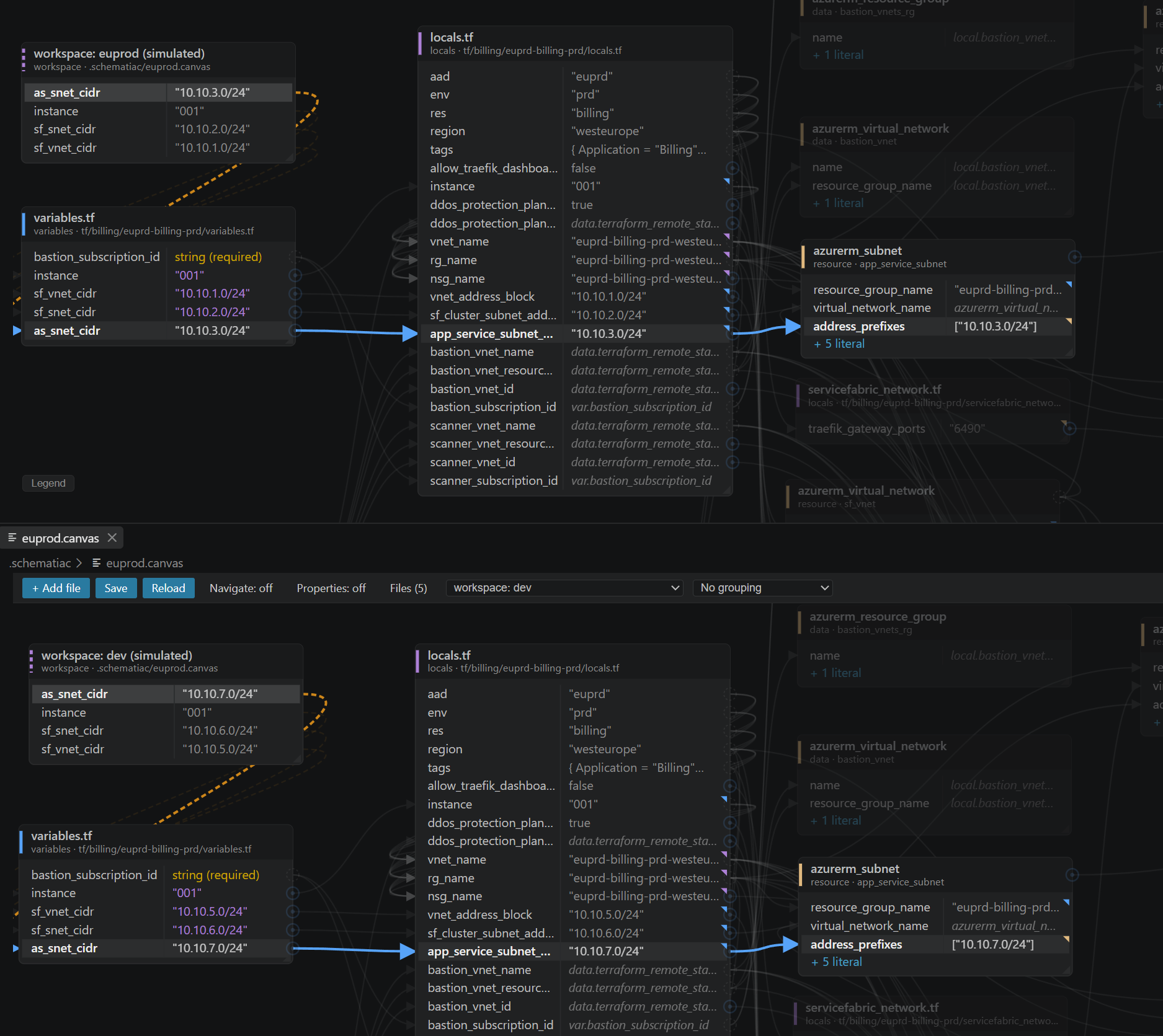
One canvas is one definition — the same model as Terraform itself. Simulated workspaces are named sets of variable values kept in the .canvas file, applied over defaults and tfvars exactly as a real workspace would inject them at plan time.
Switch the active workspace from the toolbar, or compare them all at once — with overridden values marked. See the docs for the full walk-through.
Modules
Local module sources (./, ../) load automatically when their caller is added; each appears as a box with input and output ports. Registry and git modules are roadmap.
Folder Overview
Right-click a folder for a read-only picture of a whole tree: a card per directory with what it declares, and wires for which directories call which. Terraform-only, for now.
- A few Terraform-only functions —
templatefile,cidrsubnet,try— are not evaluated yet; those rows read unresolved rather than guess. countandfor_eachare not expanded — a resource with three instances is one node.- Adding and deleting resources, and
moved-block refactoring, are roadmap. The changelog keeps shipped and planned strictly apart.
Install from the Marketplace — free through the end of 2026. Getting started takes you from install to your first write-back, or hand the same engine to your editor's AI over the MCP server.